
Ayurveda, the ancient Indian healing system, once seen as old-school or traditional, is now being practised by many, not just in India but all over the world, as a holistic way of living and getting rid of common ailments.
And among the many modern health struggles where Ayurveda is proving its worth, PCOS is right at the top. Today, one in five Indian women of reproductive age suffers from this hormonal issue, which causes irregular or missed menstrual periods, unwanted hair growth, weight gain, and other health concerns.
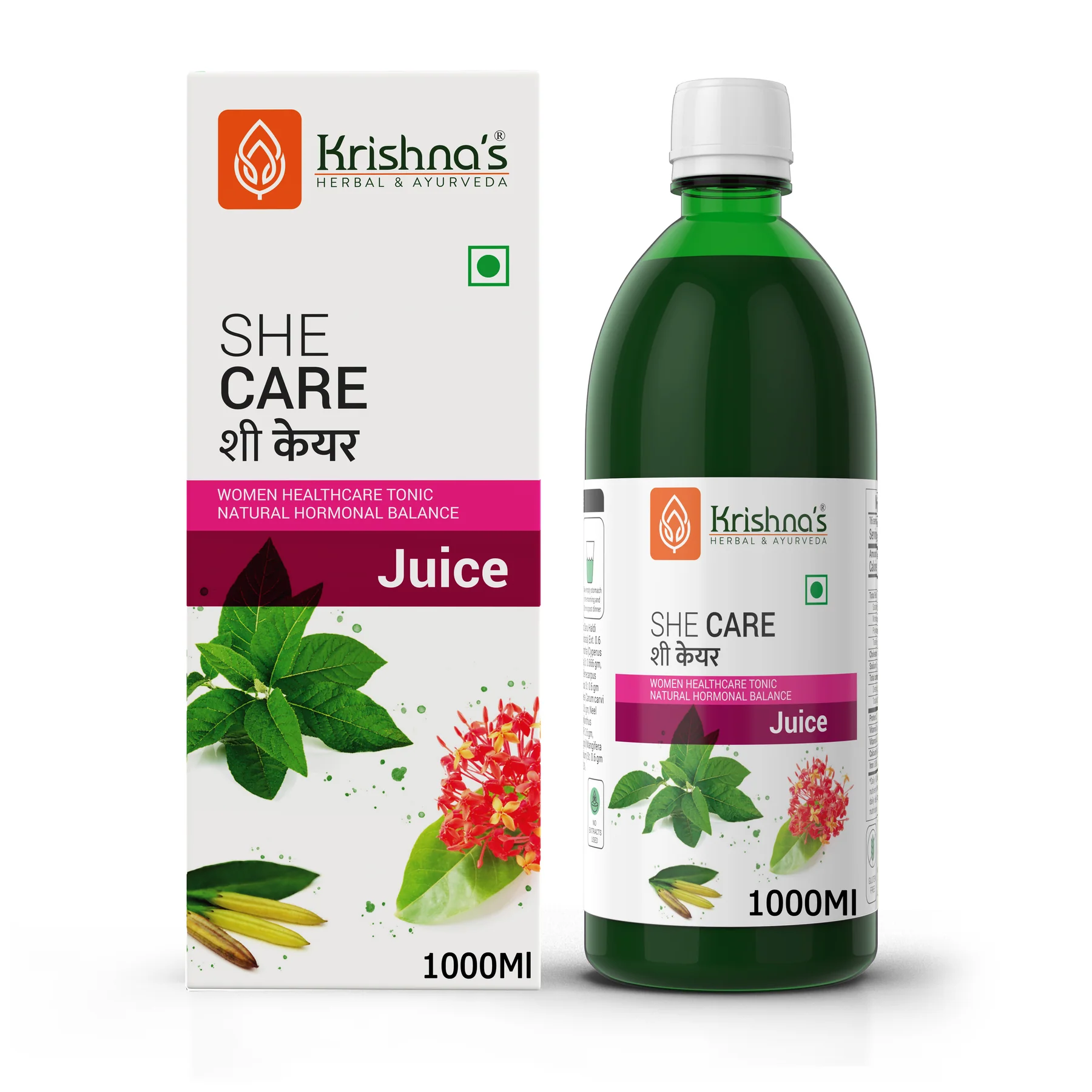
Herbs like Shatavari, Ashwagandha, and Turmeric have long been used in Ayurveda to balance hormonal health, improve energy, and bring menstrual cycles back on track naturally. If you are looking for a herbal blend for PCOS, then Krishna’s She Care Juice is a great option to begin your journey with.
But for now, we’ll give you an Ayurvedic herb guide for PCOS… so read on.
Why Are Ayurvedic Herbs Considered Good for PCOS?
Modern medicine describes PCOS as a hormonal imbalance that affects how your ovaries work. When certain hormones such as insulin and androgens rise beyond normal levels, it disturbs ovulation and leads to the formation of multiple cysts.
Ayurveda doesn’t talk about hormones the way modern science does. It explains the same condition from a deeper, body-energy perspective: Vata, Pitta, and Kapha.
Every woman has her own body type (what Ayurveda calls prakruti). If you live or eat against your nature, the doshas get imbalanced. In Ayurveda, PCOS is considered to be closely related to a Kapha imbalance.
When Kapha increases, it weakens your digestive fire (called agni), and the food you eat doesn’t digest properly. That undigested waste turns into something sticky and toxic called Ama. It affects your rasa dhatu (blood and plasma), meda dhatu (fat tissue), and artava dhatu (female reproductive system).
Because these tissues are now coated with sticky Ama, they can’t function properly. When this coating happens even at the cell level, your cells lose their intelligence, meaning they stop recognising signals like insulin. So insulin can’t enter cells, builds up in the blood, and this leads to more androgens (male hormones) being produced in the ovaries. That’s why women with PCOS often have acne, excess hair, and irregular periods.
To correct all these internal imbalances, Ayurveda recommends the use of herbs. These herbs are valued for good reason; they come straight from nature and work in tune with your body, without causing side effects like most chemical-based options do. They gently support your digestion and liver so your body can detox naturally. Most importantly, they address the real cause and help your system heal from within.
5 Best Herbs For PCOS
1. Shatavari (a uterine tonic)
If there’s one herb Ayurveda swears by for women’s health, it’s Shatavari. Often called the queen of herbs, it naturally helps in treating various reproductive and other health issues related to female health.
It helps bring your hormones back to balance in a very natural, grounded way. For women with PCOS, whose cycles have gone off rhythm, Shatavari gently works to restore that balance without pushing your body too hard.
It’s rich in natural plant compounds known as saponins, which have an estrogen-like effect. These help strengthen the menstrual system. In Ayurveda, heavy menstrual bleeding or unusual uterine bleeding is known as Raktapradar, which is considered to happen due to an aggravated Pitta dosha. Shatavari helps in balancing an aggravated Pitta. Thus, it helps control the menstrual bleeding. It also has Rasayana (rejuvenating) property, which helps you cope with stress, something that worsens PCOS by disturbing insulin and cortisol levels.
Over time, this popular herb for PCOS helps your cycles become more regular, your mood steadier, and your energy more stable.
2. Ashwagandha (stress adaptor)
Ashwagandha is one of the evergreen shrubs used in Ayurvedic medicine for its calming and restorative effects on the body. The herb is also incredibly beneficial for PCOS patients.
Among many symptoms, difficulty conceiving is the primary concern for women suffering from this health issue. In addition, there is acne, facial hair growth, and weight gain. These changes often instigate the stress, anxiety and depression linked to PCOS.
When your stress hormone, cortisol, stays high for too long, it begins to interfere with insulin and reproductive hormones like estrogen and progesterone.
Ashwagandha is a Rasayana that lowers levels of the stress hormone cortisol in your body. It has bioactive compounds, withanolides, that help in regulating the hypothalamic-pituitary-adrenal (HPA) axis. As your stress reduces, ovulation becomes more regular, mood swings ease, and overall metabolism improves.
Scientific studies back this up, too. Research published in recent years found that compounds found in Ashwagandha (flavones, lignans, and terpenes) may help improve ovarian function and reduce insulin resistance in women with PCOS. Another clinical study shows that Ashwagandha root extract helps lower cortisol and balance reproductive hormones, improving ovulation regularity and mood.
From an Ayurvedic point of view, Ashwagandha pacifies Vata and Kapha doshas, strengthens Artava dhatu (the reproductive tissue), and nourishes Ojas, the essence of vitality and immunity. Over time, women who use Ashwagandha often feel calmer, stronger, and more in sync with their natural cycle.
3. Turmeric (the anti-inflammatory herb)
If you have PCOS, you already know how your body starts working against you. There’s constant bloating, weight gain around the belly, breakouts, and constant fatigue. A big reason behind all this is inflammation. In simple terms, your body is always in alert mode, trying to fight off something. That chronic inflammation messes with your insulin, hormones, and even your mood.
Turmeric, the golden spice, is a natural anti-inflammatory powerhouse. Its active ingredient, Curcumin, helps lower inflammation and may also help with insulin resistance.
One review research of women with PCOS shows that consuming 500 to 1500 mg of curcumin per day lowered fasting insulin levels and increased the ability of the cells to react to insulin.
Better insulin control reduces testosterone levels and even improves menstrual regularity.
4. Cinnamon
Cinnamon, another powerful herb for PCOS that has a positive effect on insulin resistance. A study involving 15 women with PCOS showed the effect of this herb. These women were given cinnamon supplements for 8 weeks daily. After the 8 weeks, they saw a significant reduction in their insulin resistance.
Several studies have also found that daily cinnamon consumption improves menstrual regularity and ovulation. It also reduces inflammation and improves metabolism. Simply adding a pinch to your morning tea, smoothies, or porridge can help to regulate your hormones and cycles.
5. Triphala
Triphala is an ancient Ayurvedic herbal combination that helps women with PCOS. It is made from three fruits: Amla, Haritaki, and Bibhitaki. These three fruits improve digestion and metabolism, which lowers the body’s toxin levels and supports hormonal balance.
In women with PCOS, digestion and liver function often become weak, which disturbs insulin and hormone levels. Triphala improves both.
Takeaway
The benefits of herbs in managing PCOS are clear, but along with them, you also need to work on your lifestyle and diet. If you plan to take any herbal supplement or PCOS medicine, like Krishna’s She Care Juice, always consult an Ayurveda practitioner first.
Recent Articles






Related products

YOU MIGHT ALSO LIKE