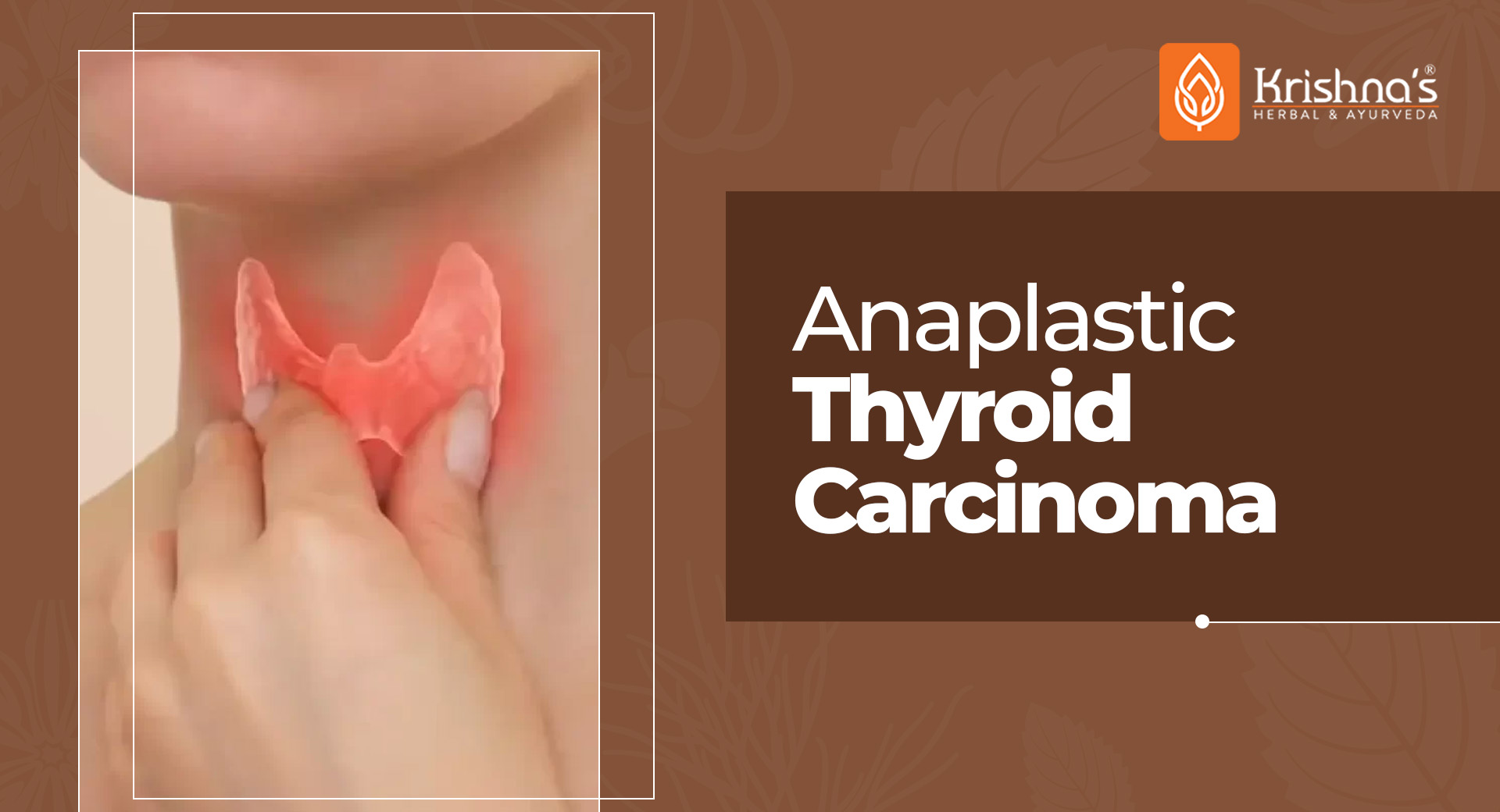
Thyroid problems are quite common today, and in many cases, they can be managed well with medicines and a supportive approach, like lifestyle changes and herbal support like Krishna’s Thyro Balance Juice.
But not every thyroid condition behaves the same way. Anaplastic thyroid carcinoma (ATC) is a rare type of thyroid cancer which is quite aggressive in nature and does not follow the same pattern as the others. Read on to learn more about it.
What is Anaplastic Thyroid Carcinoma?
This is a type of cancer that is also called undifferentiated thyroid cancer because the cancer cells lose the normal features of healthy thyroid cells and behave in a more disorganised way. This makes the condition harder to manage compared to other thyroid cancers. As it enlarges, it can press on nearby structures, leading to symptoms like difficulty breathing or swallowing, along with noticeable changes in the voice.
In most cases, ATC is already advanced at the time it is detected. For this reason, it is classified as stage IV from the beginning. Although it accounts for less than 2% of all thyroid cancers, it contributes significantly to thyroid cancer–related complications due to its aggressive nature.
Causes and Risk Factors of Anaplastic Thyroid Carcinoma
The exact cause is still not clearly understood. Researchers are continuing to study why some thyroid cells suddenly change and start growing in an uncontrolled and invasive way. What is known, however, is that this cancer tends to develop in a background where the thyroid has already been under stress for a long time.
Certain factors are commonly seen in people diagnosed with this condition. Age is one of the strongest, with most cases occurring after 60. It is also observed more often in women. A long-standing goitre or untreated thyroid enlargement can increase the risk, especially when it has been present for years without proper monitoring.
Also Read: How to balance thyroid naturally
In some individuals, this type of cancer has been observed to result from pre-existing thyroid cancers, which, over a period of time, change their form. At a deeper level, the exact cause of this condition has been related to changes at the cellular level, which result in a loss of control of the cells.
Even with these known risk factors, it’s important to understand that the condition can sometimes appear without any clear history, which is why ongoing research is still trying to uncover its exact cause.
Signs and Symptoms of Anaplastic Thyroid Carcinoma
Generally, the signs and symptoms of ATC develop suddenly and increase in severity over a short period. Unlike common thyroid problems, which develop gradually, in this case, the changes develop suddenly.
One of the earliest signs is a firm swelling or lump in the neck that increases in size quickly. As the tumour grows large enough, it starts pressing on nearby structures, leading to difficulty in swallowing, difficulty breathing, hoarseness or changing voice, persistent cough, vocal cord paralysis or a constant feeling of something stuck in the throat. Some people also experience persistent pain in the neck and loud breathing.
In more advanced situations, bone pain, swollen lymph nodes, weakness and neurological issues can also be seen.
How is Anaplastic Thyroid Carcinoma Diagnosed?
When a fast-growing lump appears in the neck, doctors don’t wait too long. The first step is usually a physical examination to check the size of the swelling, how firm it is, and whether it is fixed to nearby structures.
To understand the extent of the problem, imaging tests are done. A CT scan or MRI of the neck helps show the tumour clearly and whether it is growing from the thyroid gland or spreading into nearby areas. These scans also help doctors see if important structures like the airway are being affected.
The final confirmation is done with a biopsy. In this process, a small sample is taken from the lump with a thin needle and then examined under a microscope. This helps to confirm what type of cancer it is.
Since this type of cancer can affect breathing and voice, the doctor can also advise examination of the airway with a fiberoptic scope (laryngoscopy). This helps to see if the vocal cords are functioning properly or if they are paralysed. Blood tests are also part of the evaluation, but thyroid hormone levels are often normal despite the presence of cancer.
To check whether the disease has spread beyond the neck, tests like PET scans may be advised. Based on all these findings, this cancer is classified as stage IV from the start, due to the aggressive nature of this tumour.
Treatment Options for Anaplastic Thyroid Carcinoma
The treatment for ATC should be started as early as possible because the disease advances quickly. The plan is usually a combination of different methods depending on the stage of the tumour and the health status of the patient.
Surgery
Surgery is an option if the tumour can be removed. The most common type is debulking surgery. In this type of surgery, as much of the tumour as possible is removed, particularly the part that may be pressing on the airway.
However, in many cases, surgery may not be possible. This is because the tumour is often large, deeply invasive, or involves nearby vital structures, making complete removal unsafe. Even when surgery is done, it is usually combined with other treatments rather than used alone.
Radiation Therapy
Radiation is commonly used in this condition. It targets the tumour directly and helps slow its growth. It can also reduce symptoms like breathing or swallowing difficulty. Most of the time, radiation is given along with chemotherapy to improve its effect.
Chemotherapy
Chemotherapy helps slow down the growth of cancer cells. It is usually not given alone but combined with radiation or used after surgery. The chemotherapy medicines may not completely cure the disease, but they can help control its spread.
Targeted Therapy
In some cases, doctors check for specific genetic changes in the tumour. If certain mutations like BRAF are present, targeted medicines may be used. These treatments act more specifically on cancer cells and may help in better control of the disease. Clinical trials may also be suggested in some situations.
Supportive and Palliative Care
Along with treatment, managing day-to-day symptoms becomes very important. As the tumour grows, it can make breathing and swallowing difficult, so these issues need to be handled early.
In some cases, a small tube may be placed in the airway (tracheostomy) to help with breathing. If eating becomes difficult, feeding support may be needed to maintain strength. Pain, weakness, and general discomfort are also managed as part of care, so that the person is as comfortable as possible during treatment.
Conclusion
Being diagnosed with ATC can feel unsettling, especially because of how serious it is. However, even in such circumstances, the focus should be on getting timely treatment, appropriate guidance, and being aware of the options that are available. It may not be easy to get treatment, but support is always a part of the process. If you are struggling with this, remember, your healthcare team can help you find your way.
Recent Articles








Related products


YOU MIGHT ALSO LIKE